Every child develops at their own pace. Some need a helping hand.
Our Neurodevelopment Clinic in Naalya, Kampala brings together paediatric physiotherapy, speech therapy, occupational therapy, psychology and nutrition: one coordinated team, one plan, built around your child and aligned with medical care where needed.
A clinician replies during clinic hours: Mon-Fri 8am-6pm, Sat 9am-3pm.
When your instinct says, “let us check”
Maybe your daughter is two and not yet walking while other children her age are running. Maybe your son has words that do not seem to come out. Maybe mealtimes are difficult, noisy places feel overwhelming, school is raising concerns, or a doctor has mentioned cerebral palsy, autism or another developmental condition.
Parents are often told to wait. Sometimes children do catch up in their own time. But you know your child better than anyone, and a genuine concern deserves careful assessment rather than dismissal.
Children’s brains and bodies continue to learn and adapt as they grow. Early identification of a difficulty can open the door to appropriate support, while an assessment that finds no major concern can provide reassurance and practical guidance. Asking early is reasonable.
Support for babies, children and teenagers
The Neurodevelopment Clinic supports children with movement, communication, feeding, sensory, learning and everyday participation concerns.
Delayed milestones
Late sitting, standing, walking, talking or other developmental skills that are progressing more slowly than expected.
Cerebral palsy & movement needs
Support for movement, posture, mobility, function and participation, coordinated with the child’s medical team where relevant.
Autism & sensory differences
Practical support for communication, everyday skills, participation and sensory regulation based on the child’s individual profile.
Speech & language delay
Assessment and therapy for delayed language, unclear speech, stammering and other communication concerns.
Feeding & swallowing
Support for selected feeding, chewing and swallowing difficulties, with medical referral when safety or growth concerns require it.
School & everyday participation
Support when attention, learning, fine-motor skills, self-care or behaviour is affecting participation at school and home.
Your child’s doctor stays in the loop
Good care should not become a tug of war between professionals. If your child has a paediatrician, neurologist, orthopaedic surgeon or other consulting physician, we work with the medical plan rather than around it.
- With your consent, assessment findings and relevant progress information can be shared with the treating clinician.
- Therapy goals can be aligned with medical recommendations so the team is working in the same direction.
- If we notice something that needs medical attention, we explain this promptly and encourage appropriate review.
- If your child does not yet have a consulting doctor, we advise when medical assessment should come before or alongside therapy.
When medical review should come first
Some developmental concerns need prompt medical evaluation, including seizures, loss of skills a child previously had, significant feeding or growth concerns, or a baby who appears unusually stiff or floppy. If any of these apply, contact a paediatrician promptly. Rehabilitation can then work alongside medical care.
Five disciplines working around the same child
Instead of families chasing disconnected appointments across town, the relevant members of our team can review the child’s needs together and agree on shared priorities.
Paediatric physiotherapy
Play-based rehabilitation for sitting, standing, walking, balance, movement confidence, mobility and selected orthopaedic or neurological needs.
Speech & language therapy
Support for understanding, expression, speech clarity and communication, together with selected feeding and swallowing concerns.
Occupational therapy
Everyday childhood skills such as dressing, feeding, handwriting, play, hand use, routines and participation in different environments.
Psychology & family support
Support for emotional, behavioural and family challenges that may accompany a child’s developmental journey.
Nutrition counselling
Practical support for growth, feeding patterns and nutrition concerns using foods and routines that make sense for the family.
Parent & caregiver coaching
Practical activities and strategies are carried into home routines so useful learning continues beyond the clinic session.
Assessment, play, progress and family guidance
We listen and assess
We review movement, communication, play, feeding, thinking and behaviour, with parent observations at the centre.
We build one plan
The relevant team members agree on clear goals with you and coordinate with medical care where needed.
We treat through play
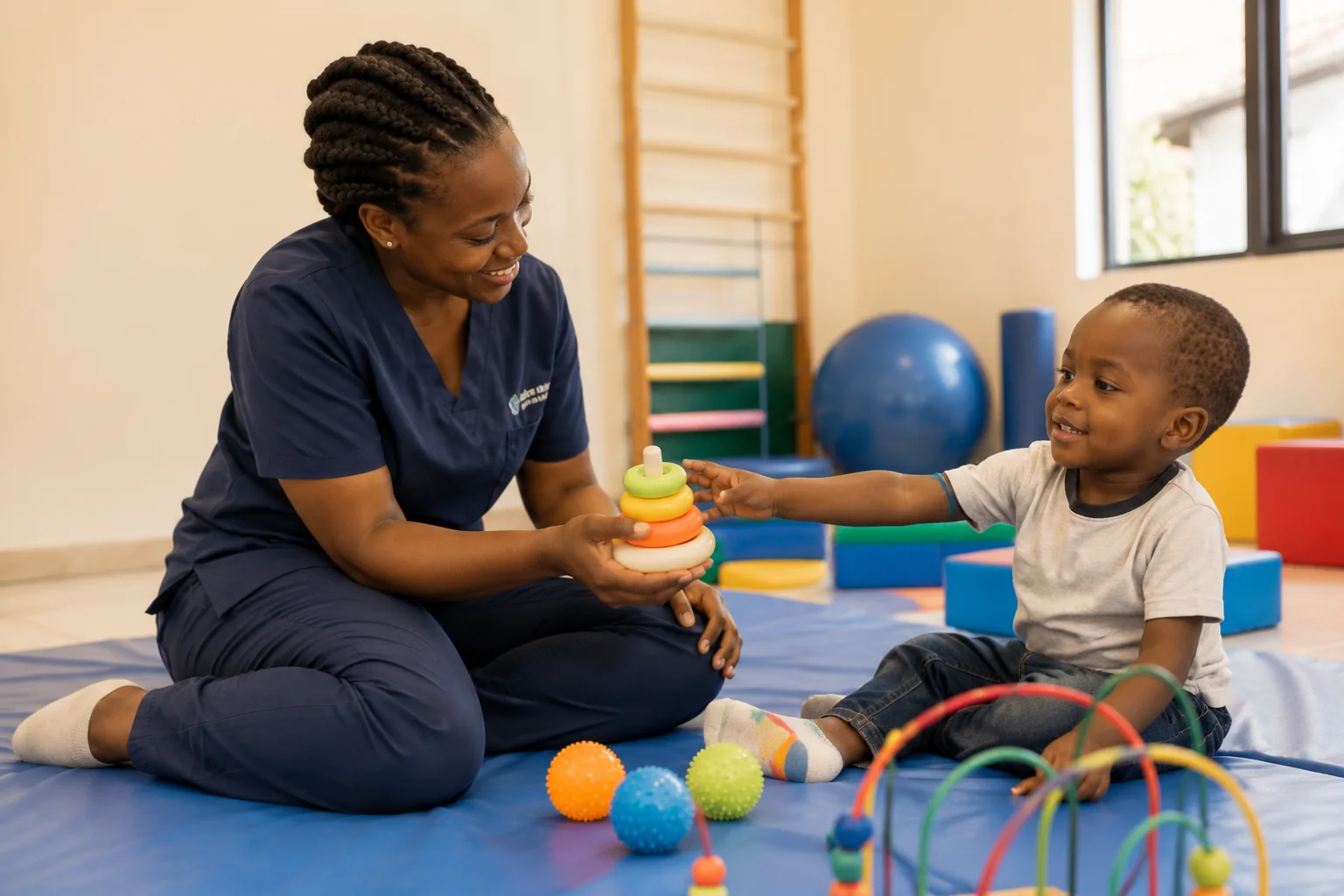
Sessions are structured for the child’s age, needs and personality, using play and meaningful activity to build skills.
We track progress
Skills and milestones are reviewed objectively so the plan changes as your child grows and learns.
We train you
Parents and caregivers receive practical home activities because useful repetition happens between appointments.
We plan ahead
We consider school participation, medical reviews and longer-term support as the child’s needs change.
Honest goals, not unrealistic guarantees
Every child has an individual developmental path. We do not promise to make one child develop exactly like another, and we do not describe therapy as a cure for autism, cerebral palsy or other lifelong conditions.
What families can expect
Careful assessment, clear explanations, evidence-informed therapy adapted to the child’s life in Uganda, measurable goals, family involvement and a team that sees the child as a whole person rather than a diagnosis.
Plan your child’s assessment
Plot 285, Spine Drive, Naalya Housing Estate, Kampala. Parking available.
Monday-Friday 8:00am-6:00pm. Saturday 9:00am-3:00pm. Saturday sessions can fill quickly.
Home visits and selected secure video consultations may be available for clinically appropriate therapy or parent coaching.
Self-pay clinic. Itemised receipts available. English, Luganda and German.
Child development FAQs
My child is not talking yet. When should I seek an assessment?
Development varies from child to child, but parents do not need to wait until a concern becomes severe before asking for professional guidance. If you are worried about communication at any age, an assessment can clarify whether monitoring, medical review or therapy is appropriate.
Will my child be labelled?
The purpose of assessment is to understand how your child moves, communicates, learns and participates, then identify useful support. Where a formal diagnosis is needed, that sits within appropriate medical or specialist care and should be explained clearly and respectfully.
Do you work with my child's paediatrician or specialist?
Yes, with your consent. Where a child already has a paediatrician, neurologist, orthopaedic surgeon or other clinician, our rehabilitation plan can be aligned with their medical care and relevant progress information can be shared.
How long will my child need therapy?
It depends on the child’s needs, goals and response to therapy. After assessment, we explain the priorities, set review points and give practical home activities so progress is supported between sessions.
Can therapy help children with autism or cerebral palsy?
Therapy does not cure autism or cerebral palsy. It can support development of communication, movement, self-care, participation and family strategies according to the child’s individual strengths and needs.
Schedule a Child Development Assessment
Message us on WhatsApp, tell us what you have noticed about your child, and one of our clinicians will guide you on the most appropriate next step. Clear answers, no pressure and care built around your family.
+256 752 045 865 | info@therehab.clinic