Occupational Therapy for Independent Living
Build practical skills for a safer and more independent life. Our occupational therapy services in Naalya, Kampala help children and adults take part more fully in everyday activities, using rehabilitation science adapted to real homes, schools, workplaces and family routines in Uganda.
Our team replies during clinic hours: Mon-Fri 8am-6pm, Sat 9am-3pm.
Recovery measured in everyday life
Rehabilitation matters most when it changes what you can actually do. Occupational therapy focuses on the activities that give daily life structure and meaning: getting dressed, preparing a meal, using your hands, writing, working, playing, managing a routine, caring for yourself and participating in family or community life.
Rather than treating a diagnosis in isolation, we look at the person, the task and the environment together. That helps us identify whether the biggest barrier is strength, coordination, sensation, memory, attention, confidence, equipment, the home setup or a combination of factors.
One question guides the plan
What do you need to be able to do again, or do more independently?
Your assessment turns that answer into practical goals that can be trained, measured and reviewed over time.
Occupational therapy for children and adults
Our therapists support people whose health, development or injury is making everyday activities harder than they should be.
Children & teenagers
Support for developmental delays, autism, sensory challenges, fine-motor difficulties, handwriting, play skills, self-care and participation at home or school.
Stroke & neurological recovery
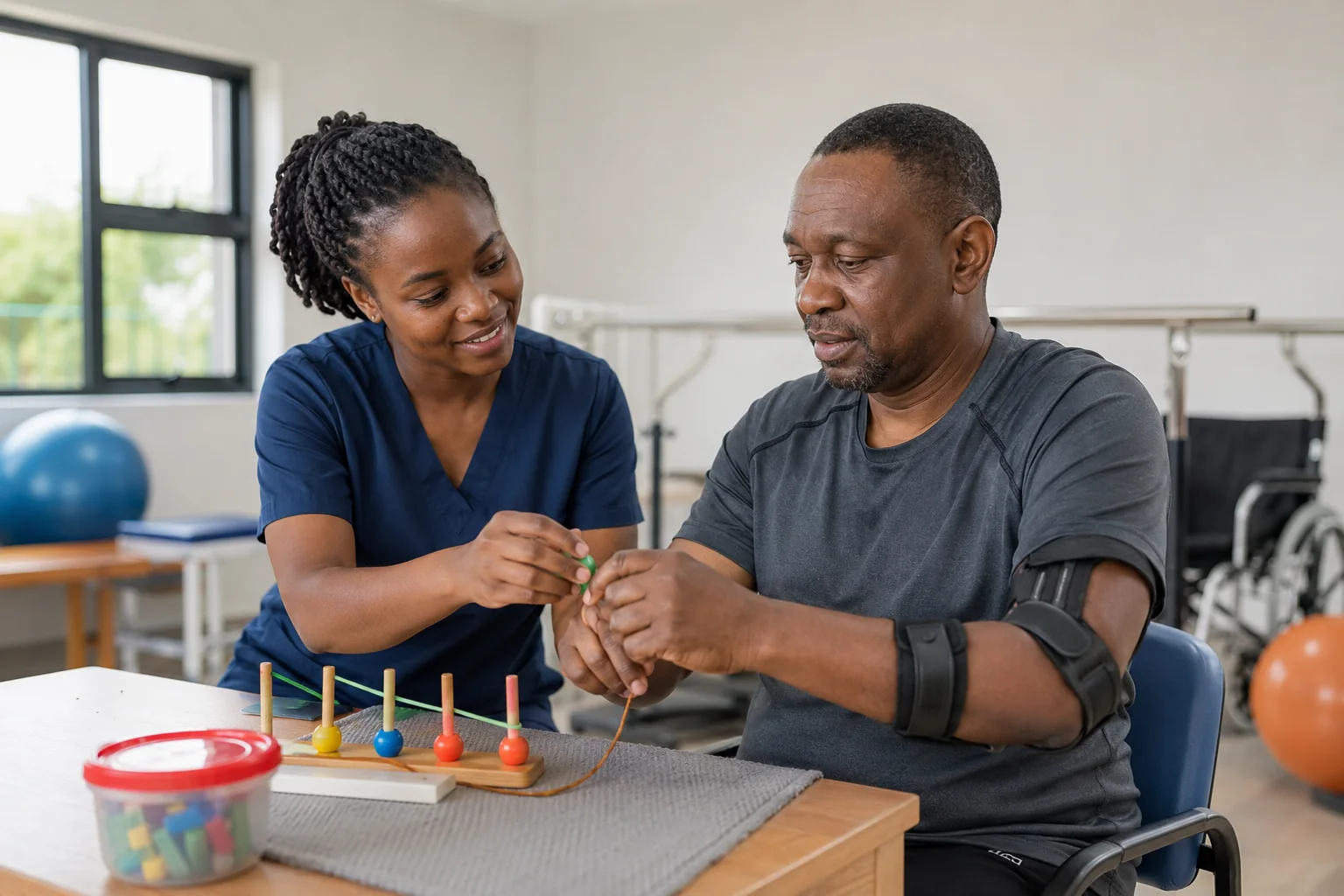
Retraining daily activities after stroke, brain injury or neurological conditions, including arm and hand use, self-care, cognition, routines and home safety.
Injury & functional recovery
Practical rehabilitation when injury, trauma or prolonged illness affects your ability to work, manage personal care, use your hands or move safely through daily tasks.
Home adaptation
Assessment of daily barriers in the home, with practical recommendations that can improve safety, access and independence.
Work & community participation
Goal-led rehabilitation for returning to meaningful roles, including work tasks, routines, productivity and community participation where appropriate.
Assistive solutions
Where clinically indicated, we can recommend or coordinate suitable assistive devices, braces, positioning or equipment to support function.
Care built around the whole person
Recovery is rarely about one problem. Our occupational therapists work alongside physiotherapy, speech and language therapy, mental health care, nutrition and other services when the situation requires it.
The result is one coordinated recovery direction rather than disconnected appointments. With your consent, family members can also be involved so useful techniques, routines and safety strategies continue at home.
Medical care still matters
Occupational therapy does not replace medical diagnosis or emergency care. New weakness, sudden confusion, severe injury or rapidly changing neurological symptoms need prompt medical assessment. Rehabilitation begins once the person is medically safe to participate.
Practical therapy for the tasks that matter
Daily living skills
Practising dressing, bathing, feeding, meal preparation and other personal or household activities in a structured way.
Hand & arm function
Activities that build coordination, dexterity, reach, grip and functional use of the upper limb according to the condition.
Thinking & routines
Strategies for attention, memory, organisation, sequencing and safe completion of everyday tasks after neurological injury.
Sensory support
For children with sensory regulation difficulties, therapy may use structured activities and family strategies to support participation in daily routines.
Environment & equipment
Adapting the task or environment, and recommending appropriate assistive solutions when they can reduce barriers to independence.
Caregiver coaching
Practical training for family members so assistance is safe, consistent and gradually reduced as independence improves.
Your occupational therapy journey
We understand your priorities
Assessment starts with the activities that are difficult and the goals that would make the biggest difference to daily life.
We assess function
We look at movement, hand use, sensation, thinking, routines, the environment and other factors affecting participation.
We build a practical plan
Treatment goals are clear, measurable and linked to real tasks rather than abstract exercises alone.
We practise and adapt
Sessions combine task practice, skill building, environmental changes and suitable strategies or equipment.
We involve home and family
Where appropriate, caregivers receive guidance so progress continues between appointments.
We review independence
The plan changes as skills improve, with the aim of safer and more confident participation in everyday life.
Plan your assessment
Plot 285, Spine Drive, Naalya Housing Estate, Kampala. Parking available.
Monday-Friday 8:00am-6:00pm. Saturday 9:00am-3:00pm.
Selected occupational therapy and caregiver support can be provided at home where travel or home assessment is clinically relevant.
Self-pay clinic. Itemised receipts available. English, Luganda and German.
Occupational therapy FAQs
What does an occupational therapist help with?
Occupational therapy focuses on the everyday activities that matter to you. That may include dressing, bathing, feeding, handwriting, using the hands, returning to work, managing routines, adapting the home or supporting sensory and developmental needs.
Is occupational therapy only for children?
No. We support both children and adults. Children may need help with development, play, school participation or sensory challenges, while adults may need rehabilitation after stroke, brain injury, trauma or other conditions affecting daily independence.
Can occupational therapy help after a stroke?
Yes. Occupational therapy can work on arm and hand function, self-care, thinking skills, home safety and the practical steps needed to resume meaningful daily activities. It is often most effective as part of a coordinated rehabilitation plan.
Will my family be involved?
With your consent, family and caregivers can be included in education, home practice and practical planning. This helps carry useful strategies into everyday life.
Do I need a referral?
You can contact the clinic directly. If your assessment suggests that medical review or another rehabilitation discipline is needed, we will explain the most appropriate next step.
Ready to take the next practical step?
Contact The Rehab Clinic in Naalya to schedule an occupational therapy assessment. Tell us what daily activities are difficult, and our team will help you understand the most appropriate next step.
+256 752 045 865 | info@therehab.clinic